
India has removed a key regulatory hurdle, allowing exporters to receive payments in Indian currency while retaining incentives under the country's foreign trade policy, a move aimed at promoting wider use of the rupee in international trade.

Prime Minister Narendra Modi and Russian President Vladimir Putin held extensive discussions to strengthen bilateral trade, defence, and energy cooperation, while also addressing the ongoing Ukraine conflict and exploring avenues for peace and resolution, with Modi reiterating India's call for dialogue and diplomacy.

Sivakasi, India's fireworks capital, is eyeing global markets as green crackers, rising demand and interest from overseas buyers offer a chance to challenge China's dominance.

US President Donald Trump has threatened the European Union with "very heavy tariffs" if he perceives their actions as hostile, specifically in response to Canada's efforts to deepen economic and strategic ties with the EU. This comes as European Commission President Ursula von der Leyen invited Canada to become the EU's first "associate member" to strengthen resilience amid global trade uncertainties and US trade policies.

Following astronaut Shubhanshu Shukla's historic visit to the International Space Station, a significant surge in interest for space science careers is observed among Indian students. Srimathy Kesan of Space Kidz India highlights this shift from traditional fields like engineering and medicine, while Nobel laureate Didier Queloz emphasises the crucial role of curious young scientists in shaping the future.

'The political leadership is very clear that we have to move towards the integration of the three services into theatre commands.'

Russian President Vladimir Putin has proposed a new investment platform, based on the New Development Bank (NDB), to fund projects in trade, infrastructure, logistics, and technology across BRICS nations, emphasising that the grouping's expanding economic cooperation is not 'against anyone' but aims to advance members' national interests.

Prime Minister Narendra Modi and US President Donald Trump held a telephone conversation to review progress in bilateral ties, covering trade, defence, and energy, against the backdrop of heightened trade friction due to the 'Lindsey O. Graham Sanctioning Russia and Iran Act of 2026'.

Navigating this geopolitical minefield requires a cold-blooded blend of immediate tactical pleading, structural domestic diversification, and aggressive collective resistance, suggests Ambassador Rajasekhar.

US Secretary of State Marco Rubio's visit to India this week underscores the complex dynamics of global energy policy, as Washington re-evaluates sanctions on Russian oil buyers amidst India's continued reliance on Russian crude.

A member of the National Traders' Welfare Board (NTWB) has urged the central government to withdraw its decision to impose a 0.4 per cent Merchant Discount Rate (MDR) on UPI transactions exceeding Rs 2,000, effective from October 15. He warned that the new charge, which will be borne by merchants, could negatively impact business growth and lead to higher prices, contradicting the government's 'ease of doing business' policy.

India has stated its commitment to protecting its economic interests and ensuring energy security after the US House of Representatives passed a bill allowing the US President to impose tariffs of up to 100 per cent on countries, including India and China, for purchasing Russian crude oil. The Ministry of External Affairs affirmed India's resolve to maintain diversified energy sourcing and has articulated its concerns to US interlocutors regarding the bill's potential implications.
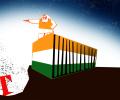
India is waiting for assurance from the US on comparative advantage over other economies under the deal.

The United Arab Emirates (UAE) has expressed intent to invest an additional $25 billion in India, with an ultimate goal of reaching $100 billion in investments, Union Minister Piyush Goyal announced. This comes as both nations plan to enhance cooperation in shipping, ports, energy, and emerging technologies, against a backdrop of expanding bilateral trade.

American industry groups sought punitive tariffs on Indian goods at USTR hearings, while Indian officials defended the country's manufacturing growth as demand-led and WTO-compliant.

Western Australia Premier Roger Cook emphasised cricket's pivotal role in enhancing India-Australia relations, fostering business development, economic ties, and trade. He highlighted the upcoming Big Bash League match in Chennai and the opening of the University of Western Australia campus in Mumbai as key initiatives strengthening bilateral cooperation and cultural exchange.

Iranian President Masoud Pezeshkian urged BRICS nations to expand trade in national currencies and build an inclusive global economic framework. He criticised "unilateral sanctions" by Western powers, stating they make emerging economies vulnerable and impact global food security. Pezeshkian emphasised BRICS' role in creating a balanced world order and highlighted Iran's geopolitical and energy capacities for cooperation.

Seven of them posted losses, led by Air India, with their combined net loss widening to Rs 31,823 crore in FY26 from Rs 17,553 crore a year earlier and Rs 1,555 crore in FY20.

'It is a blunt and dangerous attempt to pressure India to sign BTA on one-sided terms.'

In many ways, 17th century India occupied a position in the global economy comparable to that of the United States today. Just as millions of people now look towards America because of its economic opportunities, merchants, adventurers and trading companies once looked towards India.

Industry bodies representing alcoholic beverage manufacturers have welcomed the India-UK Free Trade Agreement (FTA), which will see tariffs on UK whisky and gin reduced, boosting bilateral trade and supporting premiumisation. However, domestic manufacturers are calling for state governments to withdraw concessions currently enjoyed by imported liquor brands.

India's proposal to link BRICS payment systems, including central-bank digital currencies (CBDCs), was notably absent from the grouping's New Delhi Declaration, despite being a key agenda item for India's chairmanship. This omission leaves the 16-year effort for trade in local currencies without a settled payment architecture, with the declaration only 'acknowledging' the work of the BRICS Payment Task Force.

'The large number of tariff lines in the 90-99 per cent band highlights how deeply embedded Chinese sourcing has become in India's electronics imports.'

Maruti Suzuki India's CFO, Arnab Roy, has urged the central government to introduce an amnesty scheme or an 'as-is' settlement option to resolve past indirect tax disputes, aiming to clear legacy litigation and foster growth in the automotive industry. Roy emphasised the need for a 'smarter way to address the past' to provide long-term certainty for businesses.

One of the important topics of discussion between the two leaders is expected to be the Northern Sea Route and the Chennai-Vladivostok Maritime Corridor.

Russian President Vladimir Putin is set to visit India for a three-day trip to attend the 18th BRICS Summit and engage in bilateral discussions with Prime Minister Narendra Modi. The summit will focus on strengthening strategic partnerships and addressing international issues, with Putin also scheduled to meet other world leaders.

For India, the goal is not simply to host another grand diplomatic gathering. It is to prove that a diverse coalition of emerging powers can still deliver.

Chinese President Xi Jinping addressed the BRICS summit, urging the bloc to play a significant role in achieving peace and tranquillity in West Asia and the Gulf region. He highlighted BRICS' growth over two decades, its efforts in tackling global challenges, and its steadfastness in safeguarding the interests of the Global South. Xi called for opposing the Cold War mentality, strengthening multilateralism, and promoting cooperation in emerging domains like AI, as China prepares to chair the next summit.

A two-day weekend would help employees recover physically and mentally. They would return better prepared for branch work that demands patience, judgment, and accuracy, asserts Tamal Bandyopadhyay.

US President Donald Trump is expected to sign the Lindsey O. Graham Sanctioning Russia and Iran Act of 2026 later on Friday (local time). A White House official confirmed the development to ANI without revealing further details.
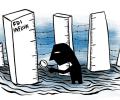
India has attracted foreign direct investment (FDI) worth approximately 4,896 crore across 29 projects since May, following the government's relaxation of norms under Press Note 2 of 2026. The revised rules permit investment without government approval from entities with up to 10 per cent non-controlling ownership by land-bordering countries.

Noida International Airport has officially commenced flight operations with an IndiGo flight from Lucknow making the inaugural landing, followed by a takeoff to Lucknow, carrying 172 villagers whose land was acquired for the project.

The Securities and Exchange Board of India (Sebi) is set to expand its artificial intelligence (AI)-based surveillance beyond trading data to include corporate filings, aiming to proactively flag financial misstatements and manipulation in quarterly results without relying solely on investor complaints.

'You have to get private investment to somewhere between 35% to 36% of GDP. It is hovering about 30%-31%.'

The Indian government has permitted Foreign Direct Investment (FDI) in an inventory-based e-commerce model exclusively for the export of domestically manufactured or produced goods, aiming to boost outbound shipments without affecting small local retailers.

'Improved law and order and transparent governance have helped change UP's investment image.'

Prime Minister Narendra Modi has urged the fintech sector to expand the global reach of India's Unified Payments Interface (UPI), connecting it with local systems in other countries to help the diaspora save on remittance costs.
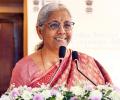
Finance Minister Nirmala Sitharaman stated that India is likely to sustain economic growth of 7 per cent or more in 2026-27, continuing the pace recorded since the Covid-19 pandemic, despite geopolitical uncertainties and supply-chain disruptions.

The United States has removed four Indian companies from its sanctions list, which had been accused of supplying advanced technology and equipment to Russia's military-industrial complex. The de-listed firms include RRG Engineering Technologies, Lokesh Machines, Galaxy Bearings, and Shaurya Aeronautics, previously sanctioned for exporting dual-use items to Russian entities.

US Ambassador to India, Sergio Gor, highlighted the evolving US-India space partnership, moving from cooperation to "co-creation" at the Bengaluru Space Expo. He emphasised joint design, funding, and co-authoring the future of human discovery, citing the NISAR satellite and India's participation in the Artemis Accords as key examples of this growing synergy.
